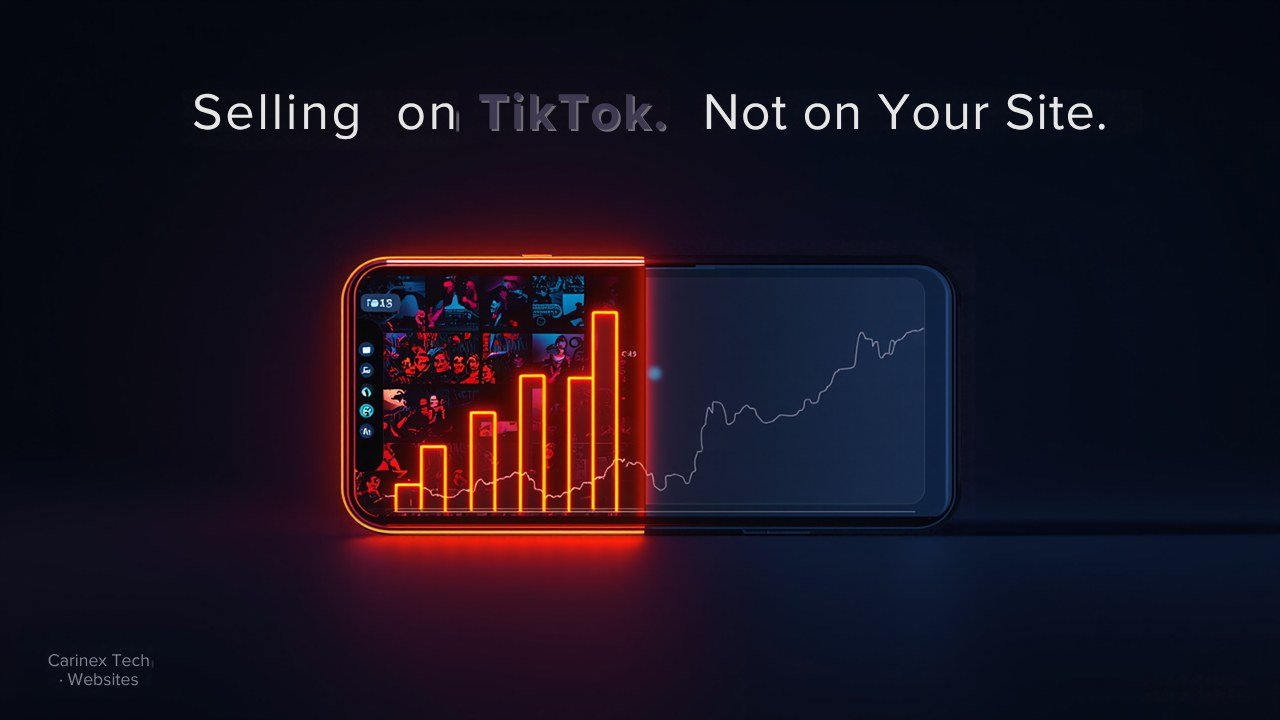
Your TikTok Shop is doing the one thing every seller wants: it’s moving product. Orders come in from live sessions and creator videos, the dashboard looks healthy, and it feels like the hard part is over. Then a buyer who loved the product searches your brand name on Google, lands on nothing, and buys from whoever showed up instead. That gap is quieter than a bad ad, and it costs more.
TikTok owns the customer. You rent the shelf.
A TikTok Shop is a storefront inside somebody else’s mall. You don’t get the buyer’s email. You can’t retarget them outside the app without paying TikTok again. If your account is flagged, paused or simply deprioritised by the algorithm, revenue stops the same day, and there is no list to fall back on. Every sale you make there builds TikTok’s relationship with that customer, not yours.
A website doesn’t replace the Shop. It’s the part of the business you actually own.
What a brand site does that the Shop can’t
- Catches the search traffic you’re already paying for. Every viral video sends people to Google your name. A site turns that into a sale instead of a dead end.
- Builds a list. Email and WhatsApp subscribers are the only audience that survives a platform change.
- Holds the story. Ingredients, sizing, who’s behind the brand, how to use it — the things a 30-second clip can’t carry and a product page in the app truncates.
- Sells the bundle, the subscription and the wholesale order. The formats TikTok Shop handles badly or not at all.
- Gives creators a clean landing page. Affiliates convert better when there’s somewhere credible to send people between lives.
The three mistakes we see most
Building the site as an afterthought. A template with a logo dropped on it looks worse than no site, because it confirms the buyer’s doubt. If the Shop is where you make money, the site is where you earn trust. It has to look like the brand people saw in the video.
Treating inventory as two separate worlds. Stock sold on TikTok and stock sold on the site come out of the same shelf. If the two don’t talk, you oversell during a live and cancel orders the next morning. The site should sit on the same stock, order and costing system as everything else.
Waiting until the Shop slows down. The best time to build the owned channel is while the rented one is loud, because that’s when the search traffic is free. Once views drop, so does the reason for anyone to go looking for you.
Calculate your exact TikTok Shop margins
Before investing in your owned storefront, understand how much platform referral fees, affiliate cuts, tax, and returns are eating into your unit economics. Use our free tool to see your real take-home profit per piece and break-even price:
What a sensible first version looks like
You don’t need a 40-page site. A first version that works is a fast homepage that matches the brand people saw on TikTok, product pages that can take an order outside the app, an email capture that gives a real reason to sign up, and one creator landing page you can hand to every affiliate. Connect it to the same stock system the Shop uses, and you’ve stopped renting your whole business.
That is roughly what we build for TikTok Shop sellers: a storefront and brand site that back up the Shop, plus the tracking and inventory systems behind a creator-led channel. If you want to see what it would look like for your brand, book a free 30-minute call. No obligation, and we’ll tell you honestly if a site isn’t your bottleneck yet.
Want this for your business?
Book a free 30-minute call. We’ll look at what you have and tell you honestly what’s worth building.